Process + Systems
Why Workflow Systems Drift — and What That Drift Is Costing Your Business Today
People change how they work constantly. Systems, approvals, and handoffs tend not to. The gap between the two is where workarounds live — and workarounds are rarely free.

The short version
Nobody sits down and decides to break the process. Drift happens one exception, one workaround, one "just this once" at a time — until the workaround is the process.
The cost of drift almost never shows up as a single line item. It shows up as slower cycle times, duplicated work, and decisions nobody can quite explain six months later.
Fixing drift isn't about enforcement. It's about building a system that matches how the work actually happens now — not how it happened when the process was written.
How drift actually happens.
01Every workflow system was designed to match how work got done on the day it launched.
That day ends. People change roles, tools get replaced, a client asks for something the process didn't anticipate, and someone — reasonably — finds a workaround. Nobody documents it. It just becomes how things get done.
The workaround becomes the process.
Do that enough times, across enough teams, and the official process and the actual process stop being the same thing. The approval flow chart says one thing. The Slack thread everyone actually uses says another.
This isn't a discipline problem. It's what happens to every system that stays static while the business around it keeps moving.
Nobody notices until it's expensive.
Drift is invisible day to day because each individual workaround is small and reasonable. It only becomes visible when someone tries to onboard a new hire, audit a process, or figure out why a deal took three weeks longer than it should have.
hours a week is a common estimate, across independent workplace studies, for how much time an employee loses to manual workarounds and duplicated process work — before anyone counts the errors those workarounds introduce.
What it's costing you right now.
Drift costs show up in three places, almost every time we go looking.
Cycle time.
Every undocumented workaround adds a step nobody accounted for — a manual check, an extra approval, a phone call to confirm something the system was supposed to confirm automatically.
Duplicated work.
When the official system and the actual process diverge, people end up keeping their own shadow version — a spreadsheet, a personal tracker — just to make sure nothing falls through. That's real time, spent twice, every single week.
Institutional memory that walks out the door.
The workaround usually lives in one person's head. When they leave, the "process" leaves with them, and whoever's left has to reverse-engineer how things actually got done.
How we close the gap.
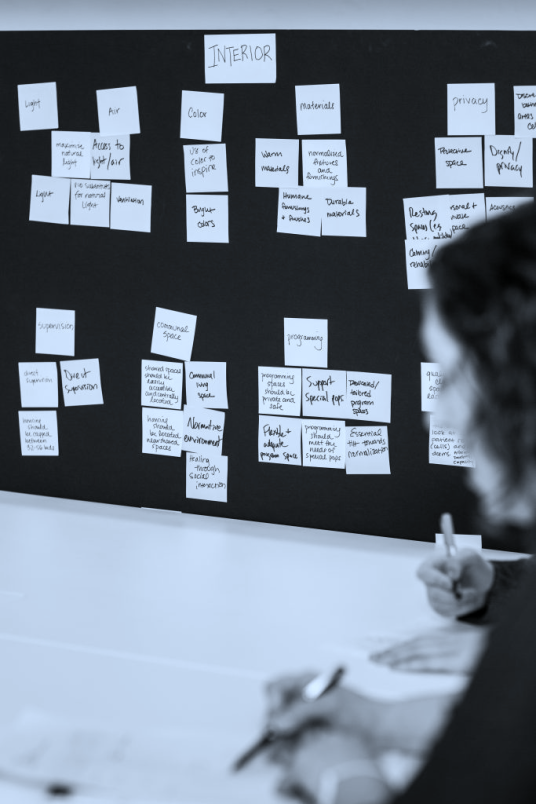
03We don't start a workflow engagement by handing you a new process to follow. We start by mapping the one you're already running — including the parts nobody wrote down.
- Map the real process, not the documented one. We talk to the people actually doing the work, not just the org chart that describes it.
- Find out why the workaround exists. Most workarounds are a rational response to something the system genuinely can't do. Fix that, and the workaround disappears on its own.
- Rebuild it to match reality — then keep it that way. A system that matches how work actually happens doesn't need to be gamed.
The goal isn't a prettier flowchart. It's a system nobody has a reason to route around.

Fix
The
Drift
Drift is normal, not a discipline failure.
Every static system falls behind a business that keeps changing.
It's invisible until it's expensive.
Onboarding, audits, and slow deals are usually where it surfaces first.
Map what people actually do.
Not what the org chart says they do.
Fix the reason for the workaround.
Not just the workaround itself.
The bottom line.
Systems don't drift because people are careless. They drift because the business kept moving and the system didn't. Close that gap and the workarounds stop being necessary.
Let's talk.
This is the same mapping exercise we run before touching a single approval flow or handoff.
GrayWire
By any means necessary.